
"The objective of captions is to level the field for audience members who cannot hear the audio as readily and/or as clearly as it was intended. So, why are we dropping the ball when it comes to foreign languages?"
Dorian Gray-Sorgin
Come take a trip with me down memory lane, back to February 5, 2023, the night of the Grammy Awards. Puerto Rican artist Bad Bunny took to the stage twice that night: first, to perform, and then, as an award winner, to pick up his prize. Both times, he spoke in his native language (Spanish), and on both occasions, the closed captions displayed by the official broadcaster went: [SPEAKING NON-ENGLISH].
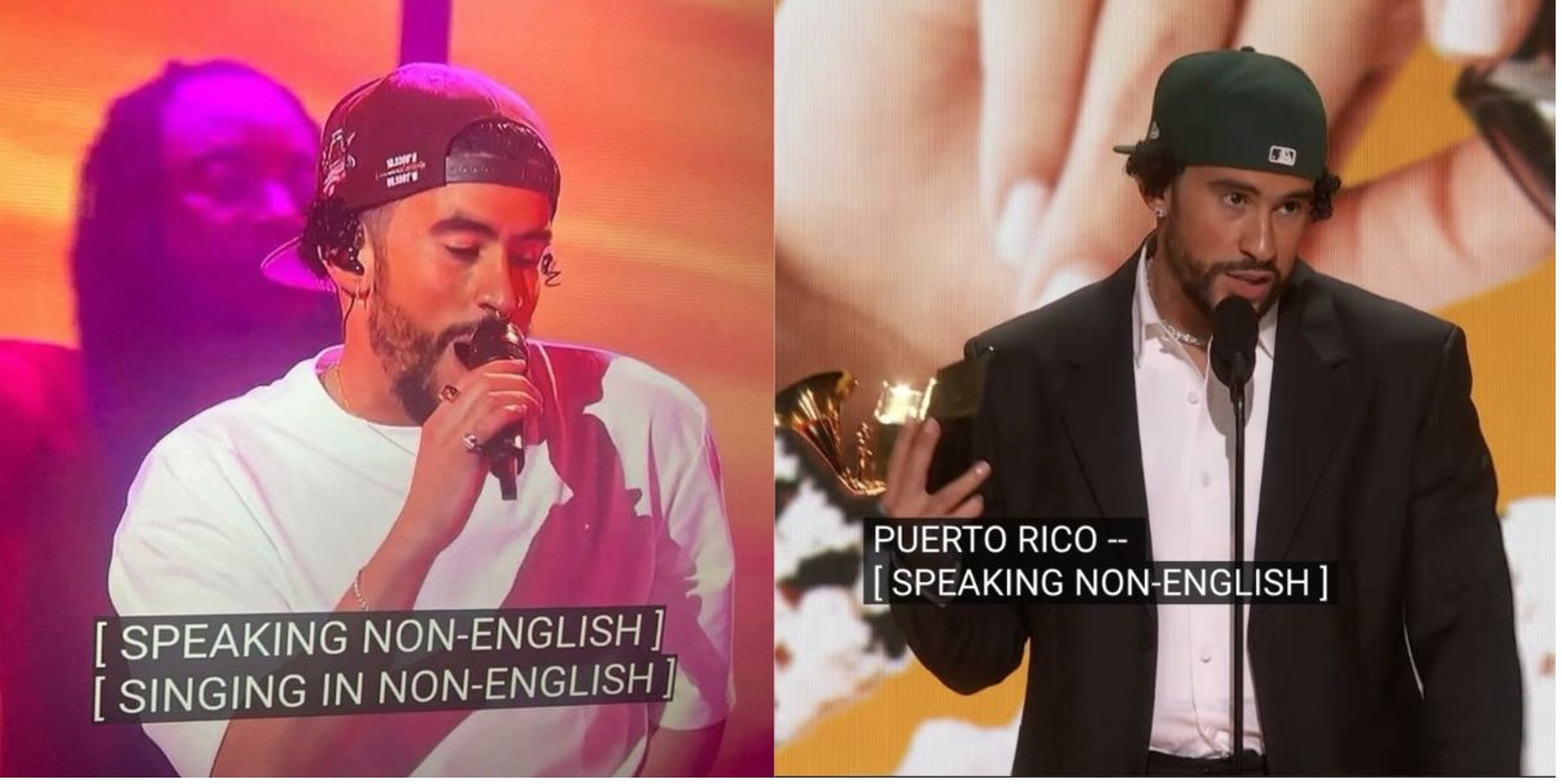
This technical misstep caught mediatic attention because of how disrespectful it was to the Hispanic audience. Many equated this to the broadcaster deeming Spanish as merely something other than English.
Aquí we [SPEAK SPANISH]
The “correct” way –that is, the method we’ve grown used to over time and practice– of captioning interventions in languages other than the ever-pervasive English would be: [SPEAKING SPANISH]. But when you come to think about it… How much better is this for someone who’s relying on captions to understand?
Captions are used by a large portion of the population, though they were originally created to make media accessible to people who are deaf or hard of hearing (D/HoH). This technology provides a transcription of the dialogue, sound effects, musical cues, and other relevant audio information.
The objective of captions is to level the field for audience members who cannot hear the audio as readily and/or as clearly as it was intended. So, why are we dropping the ball when it comes to foreign languages?
Specifically when it comes to code-switching (when a speaker alternates between two or more languages), captioners are instructed to insert [speaking foreign language] (or a variation thereof) if they cannot understand and/or transcribe the audio. This is a necessary evil –captioners are not usually required to know multiple languages. But you must admit that the experience of hearing “But what can we do? C’est la vie!” is not the same as reading “But what can we do? [speaking French],” regardless of whether or not you know the meaning of c’est la vie. By leaving it at [SPEAKING SPANISH], let alone [SPEAKING NON-ENGLISH], we are depriving the D/HoH community of fully experiencing the content as it was intended.

Code-Switching for La Cultura
This may seem like a small problem for some, but it is significant when it comes to media involving multi-lingual cultures, like ours (Puerto Rico) or Latino communities living in the US, where code-switching between languages is inherent to the way we understand the world and express ourselves. This means that odds are that a large part of their D/HoH communities will be bilingual. Wouldn’t it be less-than-equitable to provide them with only part of the content?
Mixed-language captions may not always be a feasible option, and that is perfectly reasonable in most scenarios. But if both your media and your audience are multilingual, why shouldn’t your caption provider be?
At OGMA Language Studio we strive to provide lo mejor de dos mundos in our services: we provide caption and subtitling services in English, in Spanish, and in ✨Spanglish✨. So, if you need captioners that know how to speak things other than NON-ENGLISH, look no further. OGMA can help!
Written by:
Dorian Gray-Sorgin, Traductoræ Principal
Let us tackle your language needs!
Precisión, experiencia y pericia —la excelencia lingüística está a un solo clic.
Contáctanos hoy. ¡Con gusto te asistiremos!